Bartering for Buttons: Using a Sewing Project to Teach Children About Economics.
Economics is not usually the subject that makes children jump out of their seats with excitement. Words like supply, demand, and barter can feel abstract and distant from their everyday lives.
But what if economics wasn’t taught from a worksheet…
What if it was stitched into fabric?
At the Creativity Shell, our mission has always been to use creative trades such as sewing, cooking, and art to educate and inspire the next generation of makers. When we lean into the education side of that mission, we challenge ourselves to design lessons that transform complex ideas into tangible experiences.
Bartering for Buttons is one of those lessons.
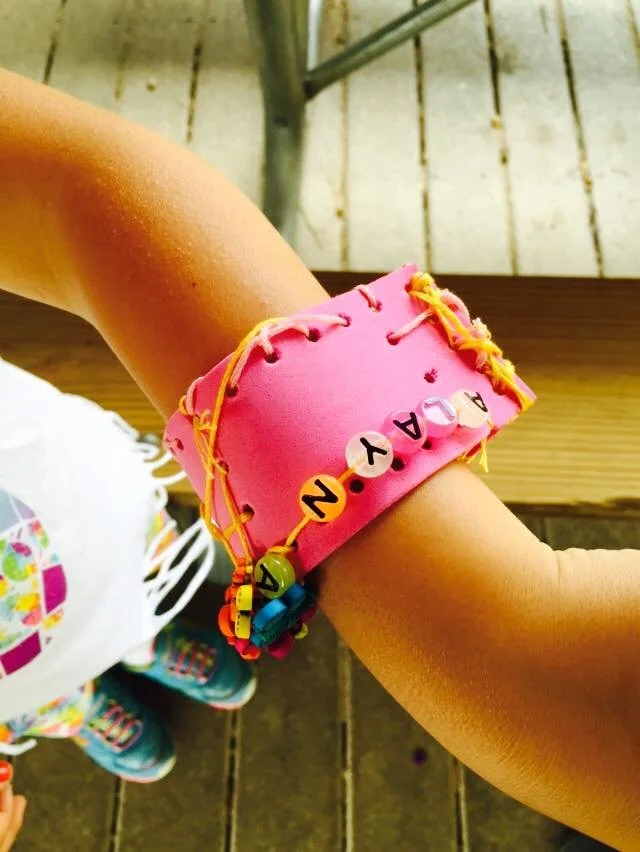
The Setup: A Choice Within a Choice
The lesson begins with what we call a “Choice Within a Choice.”
The options are pre-selected by the instructor, but students still feel ownership because they get to choose within the boundaries provided. This structure mirrors real economic systems: freedom exists, but within constraints.
Students are divided into two groups:
Vowels
Consonants
Each group receives alphabet buttons or beads based on their station. Vowel students receive A, E, I, O, U. Consonant students receive all other letters.
But that’s not all.
Students are also given limited color supplies:
Some only receive red buttons.
Some only receive green.
Others might receive blue or yellow.
Immediately, scarcity is introduced.
The Challenge
Students are given a simple sewing project:
Create a fabric bookmark and sew on buttons to spell your name.
At first, it seems straightforward. Then reality sets in.
Every child needs both vowels and consonants to spell their name.
No one has everything they need.
And just like that, economics comes alive.
The Learning Happens in the Trading
As students begin working, conversations start forming:
“I need an A.”
“I’ll trade you a red S for a green E.”
“How many buttons will you give me for this O?”
“That’s my only vowel, what will you offer?”
Without realizing it, students begin exploring:
Supply and Demand
Scarcity
Negotiation
Perceived Value
Trade-offs
Collaboration vs. Competition
Some students hoard.
Some negotiate creatively.
Some overtrade and learn about regret.
Some discover that cooperation gets them further than control.
The classroom becomes a living marketplace.
The Hidden Layers of the Lesson
What makes this powerful isn’t just the economic principles. It’s the emotional intelligence woven into it.
Students must decide:
What am I willing to give up?
Is this button worth more to me or to someone else?
Do I want to help my classmate finish?
Should I wait for a better trade?
They begin to understand that value is not fixed, it’s relational.
And then comes the bonus:
At the end of the project, every child has learned how to sew on a button.
They walk away with:
A finished bookmark
A new sewing skill
A lived understanding of basic economics
Why Sewing Makes Economics Stick
When children experience concepts physically, learning becomes embodied.
Economics stops being theoretical.
It becomes tactile.
Colorful.
Negotiated.
Stitched into something they made with their own hands.
Sewing slows the process down enough for reflection. It gives students time to think while their hands are busy. That pause is where deeper understanding forms.
Educating the Next Generation of Economists and Makers
We often say that creative trades are life skills.
Bartering for Buttons proves it.
Through a simple sewing project, children practice:
Financial literacy foundations
Decision-making
Communication
Resource management
Practical craftsmanship
This is what it looks like to truly educate and inspire.
Because sometimes, the best way to teach economics…
…is one button at a time.